
Lung Cancer Awareness Month and the importance of documenting occupational exposures
November is Lung Cancer Awareness Month.
For firefighters, occupational exposure to carcinogens is a recognized risk. Lung cancer risk in firefighters is a harder question: it depends on how repeated exposures add up across your time in the fire service.
What Research Says About Firefighters and Lung Cancer
We’ve talked about how the International Agency for Research on Cancer (IARC) classifies occupational exposure as a firefighter as carcinogenic to humans (Group 1) [1, 2].
But there’s more to consider.
We know firefighters encounter substances that can cause lung cancer. What we still need to learn is how these exposures, accumulating over the course of a firefighter’s service, affect long-term cancer risk.
Firefighters do not face a single chemical in a controlled setting. During incidents, training, and other assignments, they encounter complex mixtures of hazardous substances. Some of these substances, including asbestos, arsenic, and diesel engine exhaust, are established human lung carcinogens [2].
However, studies have not always shown that firefighters get lung cancer more often than others [3]. This doesn’t mean these exposures are safe. It shows the connection is complex.
Researchers have to consider things like smoking history, how much and how long someone was exposed, what protective gear was used, and the many years that can pass between exposure and illness.
There’s another problem.
How can we study exposures that were never recorded?
Live-Fire Training Exposures Count, Too
We usually think of dangerous exposures happening at big structure fires, but training settings are just as important to consider.
Live-fire training can produce measurable amounts of harmful substances, such as polycyclic aromatic hydrocarbons (PAHs), volatile organic compounds (VOCs), and other dangerous chemicals [4].
Exposure can depend on the type of fuel, how well the area is ventilated, the fire conditions, and the tasks being done [4].
Even after the fire is out, dangerous substances can still be in the area or on protective gear [5].
This is why you need to use your self-contained breathing apparatus (SCBA) at all times in areas with a breathing hazard, wear the correct personal protective equipment (PPE), clean up properly, and follow steps to minimize exposure during training and emergencies.
Just because training is controlled doesn’t mean exposure is.
The Problem with Trying to Remember 25 Years of Exposures
Imagine you’re in your doctor’s office after 25 years as a firefighter.
Your provider asks, “What have you been exposed to during your time in the fire service?”
You’ll probably remember the big fires, the oddities, and the calls you would rather forget. But what about all the little fires, the training fires, the vehicle fires, and the overhaul jobs?
Most firefighters can’t remember every single exposure, and that’s completely understandable. For researchers, those gaps in exposure history make the work harder.
Cancer can show up many years after exposure. Researchers need to know not just whether someone was a firefighter, but also what kinds of exposures they had, how often, how strong, and how long.
Without that information, it is far harder to spot patterns or to study how occupational exposures affect long-term health.
We can’t study what we can’t measure well.
Documenting Exposure History with the IPSDI Exposure Tracker™
Firefighters document nearly everything: apparatus inspections, equipment maintenance, training hours, and incident reports.
But what about their own occupational exposure histories?
The IPSDI Exposure Tracker™ enables firefighters to maintain a record of their occupational exposures over the course of their service, one incident at a time.
That information may be valuable when discussing occupational risks with healthcare providers, evaluating potential health concerns, or reviewing an individual’s exposure history.
Exposure Tracker doesn’t prevent cancer, determine whether exposures caused a disease, or guarantee occupational cancer benefits.
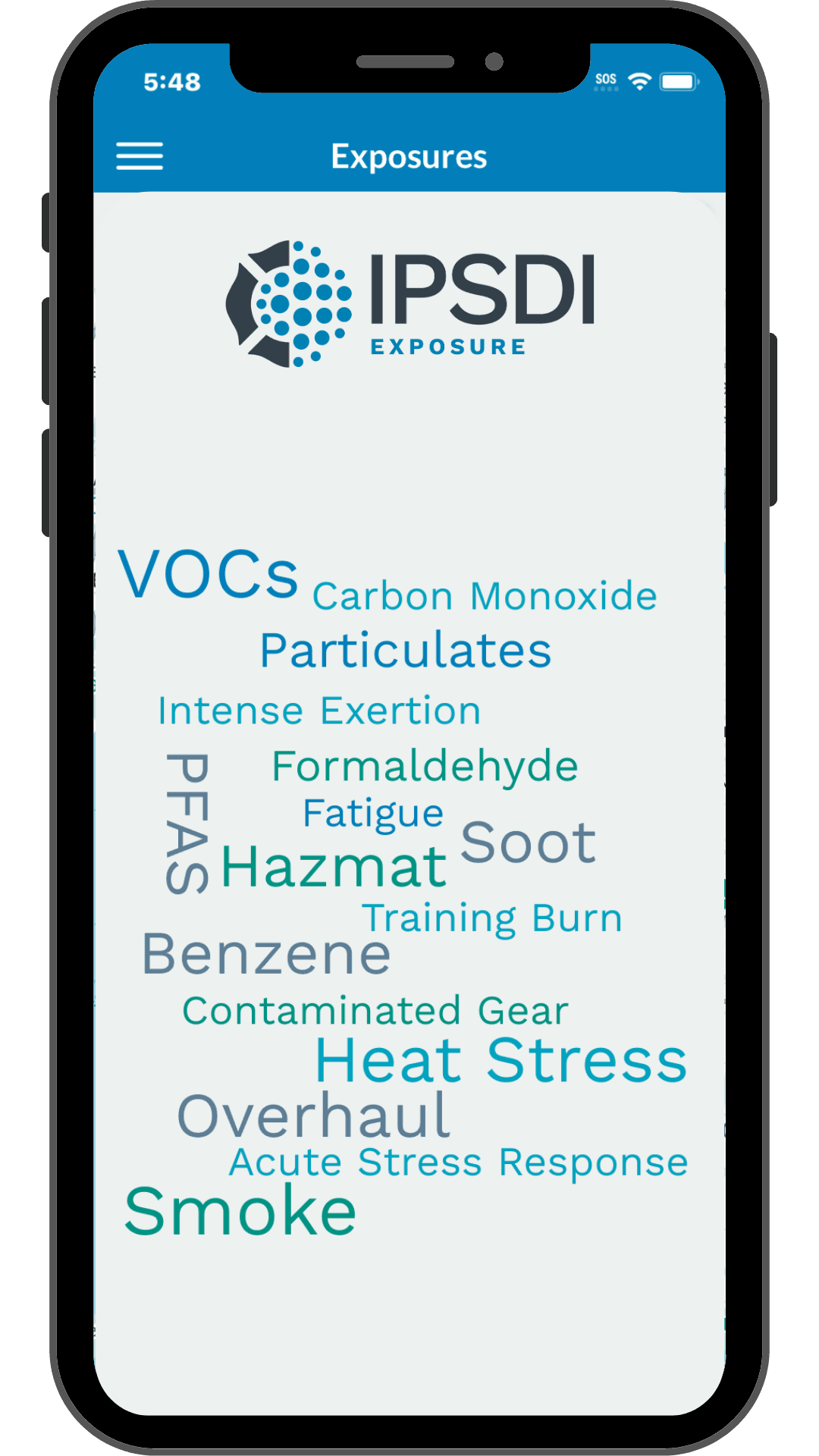
What consistent documentation does is preserve information that might otherwise be lost. With the right research methods, appropriate privacy protections, and additional health data, more complete exposure histories could also be valuable in future occupational health research.
The exposures you document today may help answer questions that haven’t been resolved yet.
What Firefighters Can Do Now
- Have the health conversation. Movember is about more than growing a mustache. Talk to your healthcare provider about your personal, family, and occupational health history. Ask which cancer screenings are appropriate for you.
- Do firefighters qualify for lung cancer screening? The U.S. Preventive Services Task Force recommends annual low-dose computed tomography (CT) screening for adults ages 50 to 80 who have at least a 20 pack-year smoking history and currently smoke or quit within the past 15 years [6]. Occupational exposure alone does not establish eligibility under these criteria. Discuss your individual risk factors with your provider.
- Take training exposures seriously. Use appropriate PPE and respiratory protection, follow decontamination procedures, and avoid unnecessary exposure during live-fire training, overhaul, and other operations.
- Track your exposures. After an incident or training evolution, take a few minutes to log the exposure in Exposure Tracker. Record what you know at that point rather than trying to remember all the details years later.
The Bottom Line
We know that firefighting involves exposure to carcinogens. We also know there are questions to be answered about how repeated occupational exposure over time affects cancer risk.
Further research, better exposure assessment, and more complete occupational histories are all essential to improving our understanding.
Related Insights
The Exposure Equation: Why the Same Hazard is not the Same Exposure
Breast Cancer in the Fire Service
Research References
- Demers, P. A., et al. (2022). Carcinogenicity of occupational exposure as a firefighter. The Lancet Oncology, 23(8), 985–986. https://doi.org/10.1016/S1470-2045(22)00390-4
- International Agency for Research on Cancer. (2023). Occupational Exposure as a Firefighter. IARC Monographs, Volume 132. https://publications.iarc.who.int/615
- DeBono, N. L., et al. (2023). Firefighting and cancer: A meta-analysis of cohort studies in the context of cancer hazard identification. Safety and Health at Work, 14(2), 141–152. https://doi.org/10.1016/j.shaw.2023.02.003
- Fent, K. W., et al. (2019). Firefighters’ and instructors’ absorption of PAHs and benzene during training exercises. International Journal of Hygiene and Environmental Health, 222(7), 991–1000. https://doi.org/10.1016/j.ijheh.2019.06.006
- Fent, K. W., et al. (2019). Contamination of firefighter personal protective equipment and skin and the effectiveness of decontamination procedures. Journal of Occupational and Environmental Hygiene, 16(10), 655–667. https://doi.org/10.1080/15459624.2019.1631309
- U.S. Preventive Services Task Force. (2021). Lung cancer: Screening. Final recommendation statement. https://www.uspreventiveservicestaskforce.org/uspstf/recommendation/lung-cancer-screening
Additional Resources
Movember Fire Service Network
IAFF Health and Safety
National Firefighter Registry for Cancer (National Institute for Occupational Safety and Health)
CDC Lung Cancer Screening
Firefighter Cancer Support Network